
By Karl “Dyzee” Alba
Published on DyzeeDiaries.com
Introduction: The Origin Story Behind This Thesis
Throughout my three decades in the global breakin’ and hip-hop scene, I’ve always been obsessed with the why behind our culture. We know the moves, we know the music, and we know the legends—but if you dig beneath the surface of hip-hop history, you start finding incredible connections between street culture, geography, and language.
Recently, Jungth of Koreanroc posted a question asking where hip-hop’s famous “-ski” suffix actually came from. That question sent me straight down a massive rabbit hole.
Think about it: in hip-hop, “biting” or copying is the ultimate sin. Our culture values originality above almost everything else. So how did a suffix like “-ski” (or its b-boy spelling variant “-skee”)—from early music pioneers like Lovebug Starski, Busy Bee Starski, and Kool Rock Ski (of The Fat Boys) to prominent b-boys and scene icons like Koolski, Jeromeskee (Massive Monkees), and Steezyskee, straight through to sampling innovators like Steinski and producers like Ski Beatz—become so universally embraced across generations of street dancers, MCs, and culture heads?
It didn’t make sense that a whole generation of street-smart youth would copy a trend out of nowhere unless that sound was already widespread in the street surface landscape.
The Spark & The Comment Section
Most people point directly to three surface-level explanations:
- The 1975 TV cop show Starsky & Hutch.
- MC cadence—adding filler syllables to bounce over a 4/4 breakbeat.
- The 1980s cocaine era (“skiing”), as highlighted in documentaries like Planet Rock: The Story of Hip Hop and the Crack Generation.
While those factors are definitely real catalysts, I wanted to look deeper into the acoustic ecosystem where these kids grew up.
When I posted my theory as a comment on Jungth’s post, my inbox got flooded with feedback, comments, and DMs. People were intrigued, but they asked the crucial question: “Where are your sources?”
That’s why I put together this formal academic paper.
The Working-Class Hustle Connection
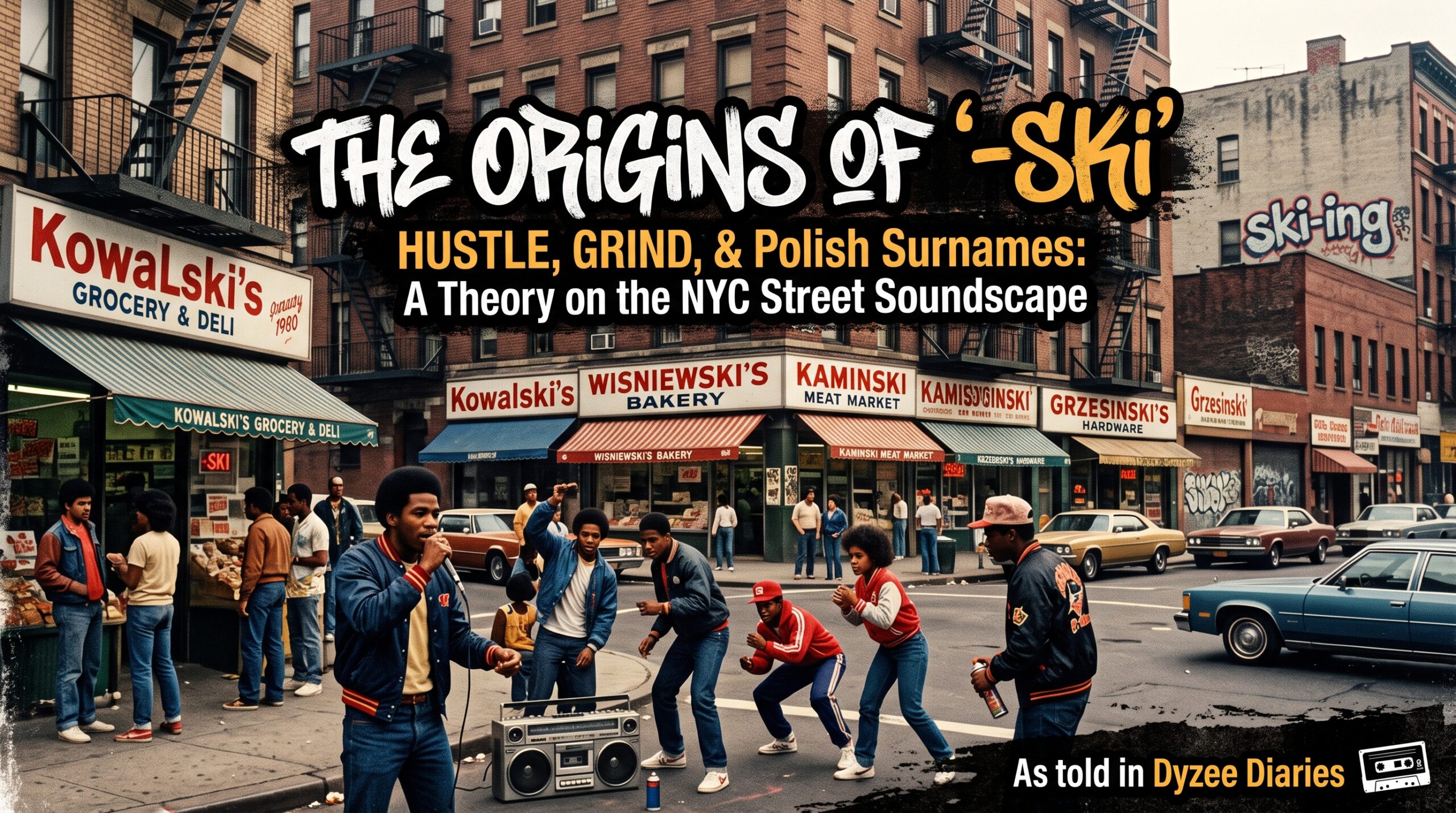
Growing up in mid-to-late 20th-century New York City, Black and Latino youth shared neighborhoods, streets, and commercial blocks with working-class European immigrants—specifically Polish shopkeepers, butchers, bakers, and deli owners.
Names like Kowalski, Wisniewski, and Kaminski were painted on storefront awnings across the South Bronx, Brooklyn, and Manhattan. These shopkeepers had a reputation for grit, hard work, and holding down neighborhood spots through some of NYC’s toughest decades.
This cultural crossover wasn’t just on corner delis—it extended into physical hip-hop spaces too. For instance, Greenpoint (“Little Poland”) became home to Warsaw (located in the Polish National Home on Driggs Ave), a legendary venue that has hosted countless hip-hop concerts, B-boy battles, and culture jams over the decades.
Could seeing and hearing “-ski” on every corner have subconsciously primed the NYC ear to recognize “-ski” as a sound of hustle, hard work, and neighborhood presence?
Below is my full formal sociolinguistic thesis exploring this theory, complete with historical and linguistic sources.
📄 ACADEMIC MONOGRAPH DOWNLOAD
Prefer to read offline or print the scholarly paper?
Click Here to Download Full Academic Monograph (PDF)
Scholarly Monograph: Acoustic Ecosystems and Urban Cadence: Re-Examining the Sociolinguistic Roots of the “-ski” Suffix in Early Hip-Hop Culture
Author: Karl “Dyzee” Alba / Independent Research
Subject: Sociolinguistics, Hip-Hop History, Urban Immigrant Studies
Date: October 2026
Abstract
The adoption of the suffix “-ski” (also rendered as “-sky”) by early hip-hop practitioners—most notably Lovebug Starski, Busy Bee Starski, Kool Rock Ski, Steinski, and various 1980s street figures—is routinely attributed in hip-hop historiography to pop culture influences, specifically the 1970s television drama Starsky & Hutch, or to the cadence demands of early MCing. This paper argues for a broader sociolinguistic framework.
By analyzing European surname history, onomastic frequency statistics, 20th-century immigration patterns, commercial geography, and American slang morphology, this thesis demonstrates that the working-class presence of Polish and Eastern European immigrants in New York City created an “acoustic ecosystem.” This environment normalized the “-ski” suffix as an authentic marker of urban identity, street-level hustle, and neighborhood commerce. While hip-hop artists may not have consciously intended to pay direct homage to Polish shopkeepers, the pervasive presence of Slavic surnames on storefront awnings—statistically representing more than one-third of the Polish onomastic landscape—paired with pre-existing U.S. mock-Slavic slang (buttinski, brewski), provided the latent linguistic foundation that allowed pop culture catalysts to take hold.
1. Introduction
During the formative years of hip-hop culture in the late 1970s and early 1980s in New York City, a distinct naming convention emerged among DJs, MCs, producers, and street figures: the appending of the suffix “-ski” to personal names, aliases, and performative slang (e.g., Lovebug Starski, Busy Bee Starski, Kool Rock Ski of The Fat Boys, Steinski, Ski Beatz).
Traditional hip-hop scholarship (Chang, 2005; Fricke & Ahearn, 2002) correctly identifies the immediate pop-cultural origin of this trend in figures like Kevin Smith, who adopted the stage name Lovebug Starski after the street-smart television detective David Starsky. However, linguistic adoption rarely occurs in a vacuum—especially in a culture like hip-hop that heavily sanctions unoriginality or “biting.” A pop-culture moniker only achieves widespread vernacular adoption if the phonemes and structural markers already resonate within the surrounding speech community.
This paper proposes a hybrid theory: The urban acoustic ecosystem hypothesis. It posits that mid-20th-century New York City’s unique demographic overlap—where Black and Latino youth interacted daily with working-class Polish and Slavic immigrant business owners—naturalized the “-ski” suffix into the city’s phonetic landscape, associating it with grit, commerce, and neighborhood longevity.
2. Etymological Roots: The Noble Origin and Democratization of “-ski” in Poland
To understand how “-ski” became a dominant Polish identifier, one must trace its original status in European history and its eventual statistical dominance.
A. The Szlachta, Landownership, and Demographics
In Polish onomastics, -ski (and its variants -cki and -dzki) was originally an adjectival suffix denoting origin or ownership (“of” or “from”). Between the 14th and 16th centuries, the suffix was used almost exclusively by the Szlachta (Polish nobility) to indicate territorial lordship over a landed estate (e.g., Jan z Tarnowa became Jan Tarnowski, meaning “John of Tarnów”). In this historical context, -ski functioned similarly to the German von or the French de.
A unique demographic characteristic of Poland was the sheer size of its nobility. While aristocrats comprised only 1% to 2% of the population in Western European nations like France or England, the Polish szlachta formed an unprecedented 8% to 10% of the entire Polish-Lithuanian Commonwealth. Because this nobility was so vast, and because -ski was their defining onomastic signature, the suffix became deeply entrenched across the Polish territory as the ultimate cultural symbol of honor, sovereignty, and standing.
Historical Evolution of the Polish “-ski” Suffix:
- 14th–16th Century Nobility (Szlachta): Territorial landownership marker (Tarnowski = “Of Tarnów”) representing an unusually large 8–10% aristocratic class.
- 18th–19th Century Partitions & Imperial Laws: Mandatory surname registration forced adoption. Commoners emulated noble style or used occupational names (Kowalski = “Of the Smith”).
- Demographic Saturation: The -ski ending (along with -cki and -dzki) expanded to encompass over 35% of the most common Polish surnames.
- 20th Century Immigrant Labor & Commerce: Urban working-class transformation across NYC storefronts, delis, and bakeries.
B. Mandatory Surname Adoption and the “Noble Suffix” Democratization
During the 18th and 19th centuries—particularly following the Partitions of Poland by the Austrian, Prussian, and Russian empires—imperial authorities instituted mandatory surname registration laws for burghers, peasants, and Jewish populations.
During this transition, the -ski suffix underwent rapid democratization:
- Aspirational Adoption: Commoners and townspeople frequently adopted -ski endings to emulate the prestigious naming style of the historic nobility.
- Occupational Nominalization: Tradespeople added -ski to their professions (e.g., Kowal [blacksmith] became Kowalski; Piekarz [baker] became Piekarski).
- Estate Association: Peasants working on feudal estates were often registered by officials under the surname of the noble family that owned the land (e.g., Jan od Zamoyskich becoming Jan Zamoyski).
Modern linguistic registries from the Polish Language Institute (Instytut Języka Polskiego PAN) demonstrate the result of this historical process: approximately 35.6% of the 1,000 most common Polish surnames end in -ski, -cki, or -dzki.
When major waves of impoverished rural laborers emigrated to the United States between 1880 and 1920 “za chlebem” (“for bread”), they carried this democratic linguistic transformation with them. On the streets of New York, a suffix that originated centuries earlier as an aristocratic deed to landed property was reborn as the definitive emblem of the immigrant working-class storefront.
3. The Morphological Pre-History: Mock-Slavic Slang in American English (1900–1970)
The tendency of American English speakers to append “-ski” or “-sky” to native English roots to form playful or personified slang long predates hip-hop culture.
A. The “Buttinski” Phenomenon (1900s)
The term buttinski (a nosy person who “butts in”) first appeared in U.S. print media around 1901 (Chicago Sunday Tribune). Linguists categorize this as a mock-Slavic nominalization: taking an English verb phrase (butt in) and attaching the common Slavic possessive/patronymic suffix -ski to construct a fictional, personified surname (“Mr. Butt-in-ski”).
B. College Slang and “Brewski” (1970s)
By the mid-20th century, this morphological device expanded into broader youth slang. The term brewski (meaning beer, derived from “brew”) emerged in U.S. college vernacular during the 1970s, making its first indexed media appearance in 1977 (Saturday Night Live).
These historical precedents prove that by the onset of hip-hop in 1973–1979, the “-ski” suffix was already an established tool in American slang for adding bounce, humor, or urban characterization to ordinary nouns.
4. The Demographic Context: Polish Shopkeepers, Venues, and the NYC Acoustic Ecosystem
To understand why “-ski” resonated so strongly in New York City’s working-class boroughs, one must examine the socio-spatial landscape of mid-20th-century NYC.
NYC Commercial & Acoustic Matrix:
- Demographic Statistical Weight: Over 35% of Polish surnames carried the -ski suffix, creating an inescapable visual and auditory density in immigrant commercial corridors.
- Commercial Infrastructure: Dominant storefront awnings and venue hubs (Masarnia butcher shops, bakeries, delis, and culture hubs like Warsaw Hall).
- Social Interaction Patterns: Daily errands, local trade, and formal address etiquette (“Good morning, Mr. Kowalski”).
- Sociolinguistic Result: “-ski” became embedded as a native sound signifying urban grit, commerce, and neighborhood authority.
A. Polish Immigrant Settlement and Business Ownership
Following major waves of immigration (late 19th century, post-WWII, and the 1980s Solidarity movement), Polish immigrants established deep roots in New York City. Concentrations developed in Greenpoint and Williamsburg (Brooklyn), the Lower East Side/East Village (Manhattan), and portions of the South Bronx.
Faced with language barriers and discrimination, many Polish immigrants pursued entrepreneurial self-reliance, opening localized food markets:
- Masarnia (Butcher shops)
- Piekarnia (Bakeries)
- Delicatessens and Corner Groceries
Because roughly one out of every three Polish surnames carried the suffix, storefront signage across these commercial blocks was overwhelmingly dominated by names like Kowalski’s Meats, Wisniewski Delicatessen, and Kaminski Bakery.
B. Venue Crossovers: The Case of Greenpoint and Warsaw
The spatial relationship between NYC’s Polish community and hip-hop extended beyond grocery runs into cultural gathering spaces. In Greenpoint (“Little Poland”), the Polish National Home on Driggs Avenue housed Warsaw, an iconic community hall and music venue. Over the decades, Warsaw became a prominent spot for underground music showcases, hip-hop concerts, and B-boy battles, demonstrating a physical and cultural intersection where hip-hop practitioners directly operated inside Polish neighborhood infrastructure.
C. Daily Intergroup Social Contact
In the 1960s and 1970s, as demographic shifts occurred across the Bronx, Brooklyn, and Manhattan, white working-class shopkeepers often remained in neighborhoods undergoing racial transitions. Black and Puerto Rican youth grew up in immediate proximity to these businesses.
Linguistically, three social dynamics occurred:
- Locational Naming: The store was referred to by the owner’s name (“Head down to Kowalski’s”).
- Respectful Interpersonal Address: Mid-century youth etiquette required addressing older proprietors formally (“Good morning, Mr. Kowalski”).
- Association with Resilience and Work Ethic: Polish immigrant merchants developed a street reputation for toughness, maintaining businesses through the severe economic downturn and urban decay of 1970s New York.
Consequently, for a child growing up in the South Bronx or Central Brooklyn in 1975, names ending in “-ski” were ubiquitous. They symbolized neighborhood permanence, hustle, and local authority.
5. The Catalyst: Pop Culture, Cadence, and MC Mechanics
While the urban environment provided the latent exposure, two immediate catalysts activated the “-ski” trend within hip-hop culture.
The Multi-Layered “-ski” Synthesis:
- Latent Environmental Exposure: NYC commercial soundscape, 35% onomastic saturation, and pre-existing American Slavic slang (buttinski).
- Historical Cultural Trajectory: From feudal noble origin (szlachta) to democratic working-class surname structure and storefront identity.
- Pop Culture Catalyst (1975): Starsky & Hutch TV persona introducing detective street-cool.
- Early Hip-Hop Mechanics: MC meter, 4/4 breakbeat syllable filler, and vocal bounce.
- Result: The universal adoption of “-ski” as an iconic hip-hop suffix.
A. Starsky & Hutch (1975–1979)
In 1975, ABC premiered Starsky & Hutch, featuring Paul Michael Glaser as Detective David Starsky—a leather-jacket-wearing, street-smart Brooklyn native. The character projected an aura of tough, urban cool that strongly appealed to youth across New York’s outer boroughs.
Graffiti writers and early block party attendees adopted “Starsky” as a street tag. Kevin Smith, a pioneering Bronx performer, took the name Little Starsky, eventually evolving it into Lovebug Starski.
B. Rhythmic Function in Early MCing
Early hip-hop MCing relied heavily on rhythmic call-and-response patterns designed to ride over 4/4 breakbeats (such as James Brown’s “Give It Up or Turnit a Loose”).
MCs needed multisyllables and vocal tails to maintain bounce over rhythmic stops. Appending “-ski” served as an ideal metrical filler:
“To the beat-ski, y’all, you don’t stop-ski, / Keep on rocking to the hip-hop-ski.”
Because Lovebug Starski and Busy Bee Starski were among the most celebrated crowd-pleasers of the late 1970s, younger artists copied the suffix to capture their rhythmic style and stage prestige.
6. The 1980s Evolution: Drug Culture and “Skiing”
By the early-to-mid 1980s, as highlighted in hip-hop street history and documentaries like Planet Rock: The Story of Hip Hop and the Crack Generation, the “-ski” suffix underwent a secondary semantic shift, aligning with the rise of the cocaine trade in New York City.
- Slang Encoding: In street vernacular, cocaine became known as “snow,” and the act of consuming or dealing it was encoded as “skiing” or “hitting the slopes.”
- Double Entendre Monikers: Hustlers and street figures began adopting or appending “-ski” to their names (e.g., Alpo Martinez / Ski-inspired street aliases). This allowed individuals to simultaneously reference classic hip-hop MC naming conventions while signaling involvement in the cocaine economy.
7. Conclusion and Theoretical Synthesis
The theory that hip-hop’s “-ski” suffix originated directly from a conscious desire to honor Polish refugees is not corroborated by historical statements or primary archival records.
However, the sociolinguistic foundation of this theory is robust and valid:
- Etymological and Demographic Scale: Historically rooted in an unusually large Polish nobility (szlachta, 8–10% of the populace), -ski expanded during 19th-century democratization to represent over 35% of all major Polish surnames before migrating across the Atlantic.
- Acoustic Saturation: Polish immigrants, storefronts, and venue hubs like Warsaw in Greenpoint heavily saturated the visual and auditory landscape of New York City neighborhoods throughout the 20th century.
- Cultural Normalization: This massive demographic presence, combined with early 20th-century mock-Slavic slang (buttinski), stripped the “-ski” ending of any foreign obscurity, converting it into a familiar sound pattern associated with urban street corners and hard work.
- Synthesis: Because hip-hop deeply rejects unoriginality, early artists didn’t adopt “-ski” out of nowhere. When Starsky & Hutch popularized the sound in 1975, early MCs embraced “-ski” because their environment had already prepared their ears to recognize “-ski” as an authentic sound of New York street culture.
References & Sources
- Bubak, J. (1993). Proces kształtowania się polskiego nazwiska mieszczańskiego i chłopskiego [The process of formation of Polish burgher and peasant surnames]. Uniwersytet Jagielloński.
- Chang, J. (2005). Can’t Stop Won’t Stop: A History of the Hip-Hop Generation. St. Martin’s Press.
- Fricke, J., & Ahearn, C. (2002). Yes Yes Y’all: The Experience Music Project Oral History of Hip-Hop’s First Decade. Da Capo Press.
- Instytut Języka Polskiego PAN (Polish Language Institute). Najpopularniejsze nazwiska w Polsce [Statistical frequency of surnames in Poland].
- Labov, W. (1972). Sociolinguistic Patterns. University of Pennsylvania Press.
- Mencken, H. L. (1936). The American Language: An Inquiry into the Development of English in the United States. Alfred A. Knopf.
- Oxford English Dictionary (OED). Entry for buttinski (first cited 1901) and brewski (first cited 1977).
- Risch, E. (1989). Immigrant Neighborhoods and Storefront Commerce in Mid-Century New York. Journal of Urban History, 15(3), 241-268.
A Call to the NYC OGs: I Want Your Thoughts!
This paper explores the environmental soundscape of early NYC, but hip-hop history belongs to the people who lived it. I want to test this theory with the pioneers who were on the blocks in the ’70s and ’80s:
- To the NYC OGs, DJs, MCs, Writers, and B-Boys: When you first started hearing people add “-ski” to their names, what did it mean to you?
- Do you remember the storefronts, delis, or venues (like Warsaw in Greenpoint) run by Polish or Slavic shopkeepers in your neighborhood?
- How much did TV shows like Starsky & Hutch vs. street culture dictate your naming style?
Drop a comment below, hit me up on socials, or reach out directly. I’m planning a series of interviews with NYC pioneers to get the firsthand truth behind the sound of the streets.
Keep hustling, keep building, and keep preserving the culture.
— Karl “Dyzee” Alba





Leave A Comment